Black Buck
Corporate
Granby
Musketeer

| Operation Black Buck |
Operation Corporate |
Operation Granby |
Operation Musketeer |
|
| Operation Granby Background Equipment Buccaneer Challenger Chinook Gazelle Hercules Jaguar JP233 Lynx Nimrod Puma Sea King Sea Skua Tornado Victor Warrior Battles Aftermath Books
|
BackgroundIn 1980, Iraqi dictator, Saddam Hussein invaded neighbouring Iran. He believed that he could win a quick decisive victory because of the turmoil caused by the recent Iranian revolution, and because he believed that many Iranian officers who had served under the Shah would not fight for Iran's new Islamic regime. 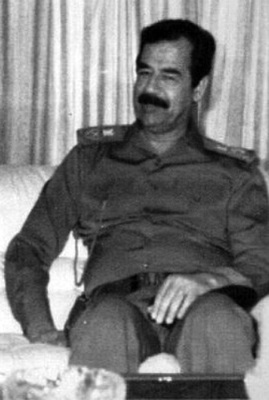 As with so many of Saddam Hussein's decisions, the invasion of Iran turned out to be a disasterous miscalculation. The Iranian people rallied around their regime, and offer stout resistance to the Iraqi advance. The war dragged on until 1988 with tremendous loss of life and at huge cost to both nations. And, when a ceasefire was eventually agreed between Iraq and Iran, Iraq found itself in saddled with enormous financial debts incurred as a result of the huge sums spent on the war. In 1989, Iraq requested that Kuwait forgive its debts, however the Kuwaitis refused. Additionally, Iraq try to increase its income by getting OPEC to agree to increase the price of oil by cutting production, however Kuwait and the United Arab Emirates frustrated this plan by increasing their own petroleum production. Iraq also claimed, baselessly according to the Kuwaiti government, that Kuwait was stealing Iraq's oil by slant-drilling into the Iraqi part of the shared Rumaila Oil Field, and demanded compensation for this. Realizing that Iraq could solve its economic problems by seizing control of the lucrative Kuwaiti economy, and misinterpreting somewhat ambiguous statements from the American ambassador April Glaspie as giving a green-light to military action, Saddam Hussein ordered his forces to invade Kuwait. In the early hours of August 2nd 1990, Iraqi forces crossed the border and drove towards Kuwait City. The Kuwaiti military did not have its forces on alert and was caught by surprise. In any case, despite offering spirited resistance, Kuwait's small military was quickly overwhelmed. Some surviving Kuwaiti forces were able to flee to Saudi Arabia and Kuwait. Following the invasion, the United Nations and Arab League quickly passed resolutions demanding Iraqi withdrawal, and placing economic sanctions on Iraq. Additionally, fearing that Iraq would now invade Saudi Arabia, American military forces, began to arrive in the region, with the objective of preventing any such attack (Operation Desert Shield). Iraq responded by announcing its complete annexation of Kuwait, holding Western hostages as "human shields" (although these hostages were later released), and offering to withdraw only if various other conflicts and disagreements around the Middle East were also resolved. In addition to US forces, a Coalition of 33 other countries was assembled to oppose Iraq. The United Kingdom made the largest contribution of any European nation, which included around 43,000 troops, and forces from the British Army, Royal Air Force (RAF), Royal Navy, and Royal Fleet Auxiliary.  Over the next few months, a series of UN resolutions were passed by the Security Council. The most crucial of these, was Resolution 678 which was passed on November 29th 1990, setting a deadline of January 15th 1991 for Iraqi withdrawal, and authorized the Coalition to use "all necessary means" (i.e. force) to achieve Iraqi withdrawal. On January 17th 1991, the Coalition began to launch air attacks on Iraq and Iraqi forces in Kuwait. Over the next six weeks, bombing greatly reduced Iraq's military capabilities. As a result of the success of the air campaign, as well as because of superior training, tactics and equipment, the Coalition was able to drive the much vaunted Iraqi army out of Kuwait in a ground-war lasting just 100 hours.  |
| |
Note: This site is not affiliated with nor endorsed by any military or government organization. Copyright © 2007-2026, Answers 2000 Limited CERTAIN CONTENT THAT APPEARS ON THIS SITE COMES FROM AMAZON SERVICES LLC. THIS CONTENT IS PROVIDED 'AS IS' AND IS SUBJECT TO CHANGE OR REMOVAL AT ANY TIME. CERTAIN CONTENT THAT APPEARS ON THIS SITE,COMES FROM AMAZON EU S.à r.l. THIS CONTENT IS PROVIDED 'AS IS' AND IS SUBJECT TO CHANGE OR REMOVAL AT ANY TIME. Disclosure: Our company's websites' content (including this website's content) includes advertisements for our own company's websites, products, and services, and for other organization's websites, products, and services. In the case of links to other organization's websites, our company may receive a payment, (1) if you purchase products or services, or (2) if you sign-up for third party offers, after following links from this website. Unless specifically otherwise stated, information about other organization's products and services, is based on information provided by that organization, the product/service vendor, and/or publicly available information - and should not be taken to mean that we have used the product/service in question. Additionally, our company's websites contain some adverts which we are paid to display, but whose content is not selected by us, such as Google AdSense ads. For more detailed information, please see Advertising/Endorsements Disclosures Our sites use cookies, some of which may already be set on your computer. Use of our site constitutes consent for this. For details, please see Privacy. Click privacy for information about our company's privacy, data collection and data retention policies, and your rights. Contact Us Privacy Terms of Use Advertising/Endorsements Disclosures In Association With Amazon.com Answers 2000 Limited is a participant in the Amazon Services LLC Associates Program, an affiliate advertising program designed to provide a means for sites to earn advertising fees by advertising and linking to Amazon.com. In Association With Amazon.co.uk  Answers 2000 Limited is a participant in the Amazon EU Associates Programme, an affiliate advertising programme designed to provide a means for sites to earn advertising fees by advertising and linking to Amazon.co.uk. As an Amazon Associate, our company earns from qualifying purchases. Amazon, the Amazon logo, Endless, and the Endless logo are trademarks of Amazon.com, Inc. or its affiliates. All trademarks are property of their respective owners. All third party content and adverts are copyright of their respective owners. |